History-inspired, small-batch sweets, savories & gifts made for discovery.
Seeds of Antiquity. Flavors of Today.
Flavors that travel across time and geography—inspired by ancient traditions and old-world confectionery for modern tables. Handcrafted in Double Oak, Texas. Gluten-free.
Follow the story behind the flavor.
Explore the history, ingredients and traditions that inspire every batch.
Give something worth remembering.
Thoughtful sweets and savories, beautifully curated for gifting.
Give guests something to talk about.
Thoughtful pairings and global flavors designed to spark connection and create memorable experiences.
Think Outside the Candy Box.
The House of Sweet Alchemy
Your Ticket to a Journey Across Time and Geography.
A curated experience of rare flavors, historic traditions and seasonal discoveries, shared throughout the year.
- Member-only creations
- Early access to select releases
- Historical stories and flavor discoveries
Shop Sweet Alchemy
Small-batch sweets and savories, made for discovery.
Our handcrafted, gluten-free sweets and savories are inspired by ancient traditions, Mediterranean kitchens, old-world European confectionery and modern tables.
Made in small batches in Double Oak, Texas, the collection changes regularly with seasonal creations and experiments. Inquire to confirm current availability and coordinate local pickup or delivery.
Sweets
Confections with a storied past and a modern twist.
Savories
Savory traditions, reimagined for modern snacking.
Time-honored confections for modern days.
From ancient traditions to modern tables, our sweets bring history, craftsmanship and unforgettable flavor together.
Most selections begin around $6–$8, depending on format, size and presentation. Prices shown are starting prices. Availability varies.
Savory traditions, reimagined for modern snacking.
Globally inspired crisps, crackers, clusters and savory bites—handcrafted in small batches and always gluten-free.
Most selections begin around $6–$8, depending on format, size and presentation. Prices shown are starting prices. Availability varies.
Discover Sweet Alchemy
History, flavor and curiosity in every bite.
From ancient traditions and global ingredients to our kitchen in Double Oak, Sweet Alchemy is a journey of flavor, story and community. Follow along, find us in person and explore the inspirations behind our confections.
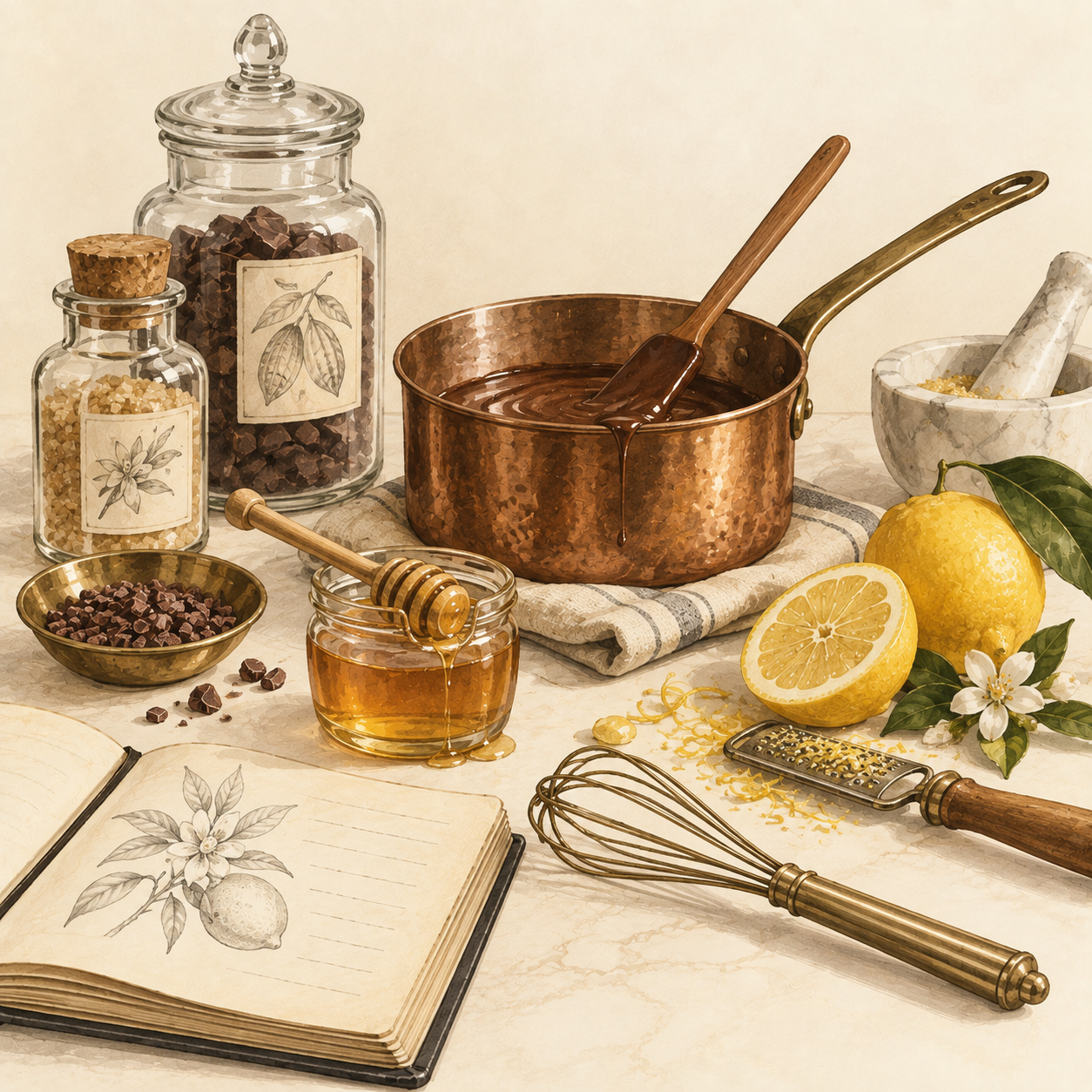
Follow the Alchemy
New releases, seasonal flavors, kitchen experiments, market updates and behind-the-scenes glimpses.
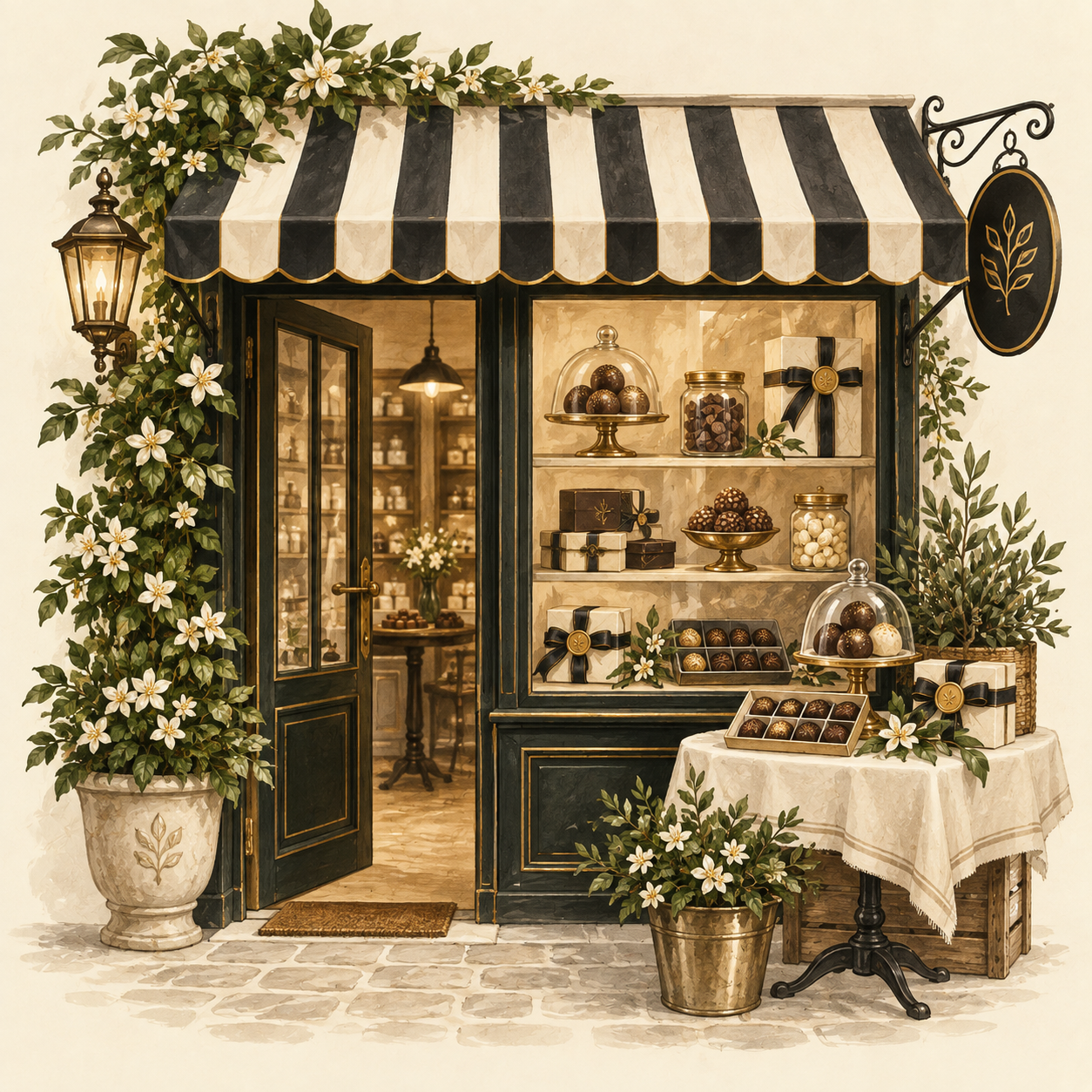
Find Sweet Alchemy
Current retail partners include The Local Markethouse and Wise Roots Market, with additional markets, pop-ups and events announced seasonally.
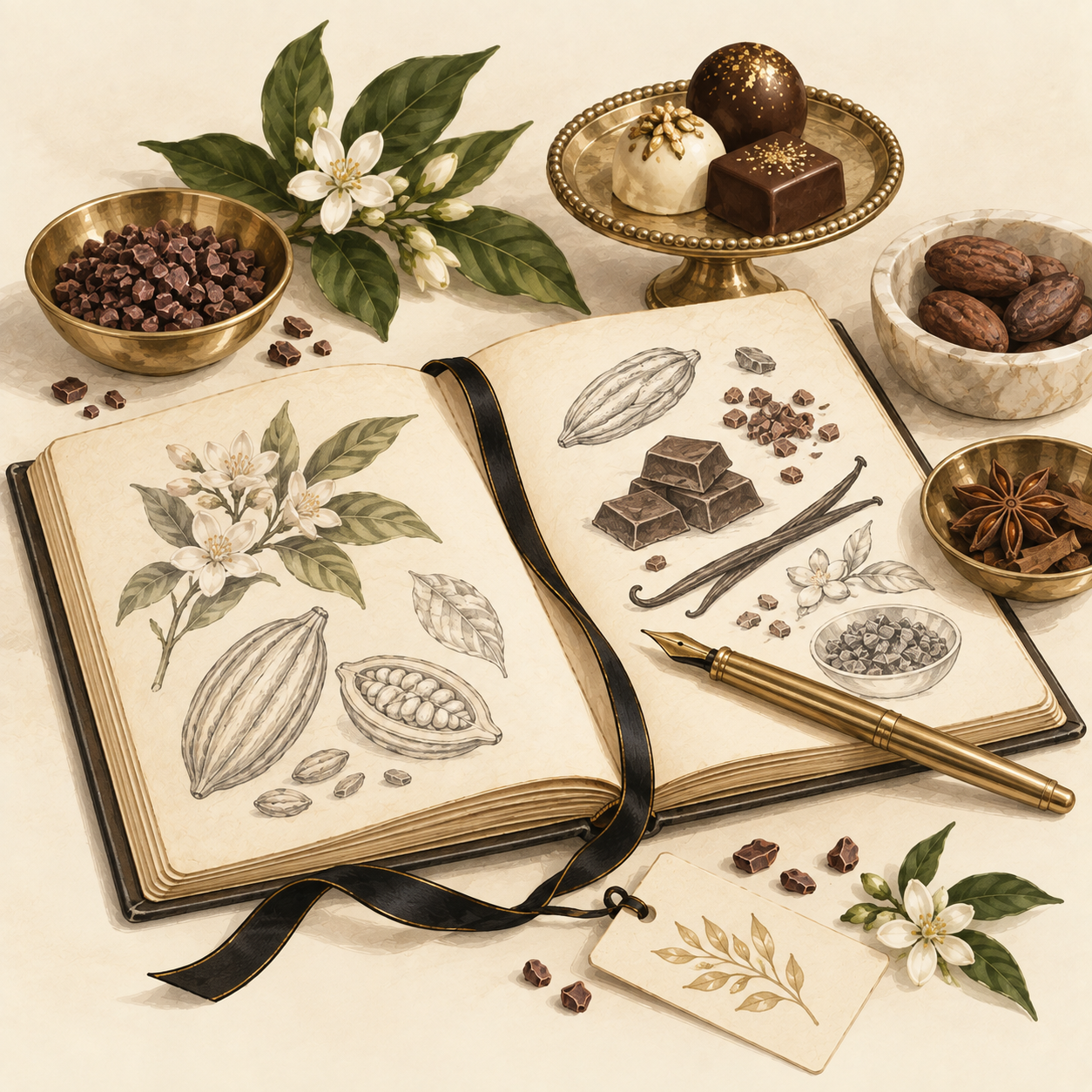
Alchemist's Notes
Food history, ingredients, techniques and the inspirations that shape our confections.
Sweet Alchemy Brings a Taste of History to the Robson Ranch Farmers Market
A look at the story, inspiration and confections behind Sweet Alchemy. — Robson Ranch Pioneer Press
The House of Sweet Alchemy
An invitation to go deeper.
Seasonal previews · Member-exclusive offerings · Historical insights and kitchen notes.
Alchemist's Notes
Food history, ingredients, techniques and the inspirations that shape our confections.
Have you ever bitten into something you were certain would be soft?
You begin delicately, with your front teeth—and immediately realize you've miscalculated. Instead of yielding, the food pushes back. You stop, reposition the bite, recruit your molars and try again.
It is a remarkably unpleasant experience.
Texture can make—or quite literally jaw-break—the eating experience.
Beyond the Five Senses
Eating is one of our most multisensory experiences.
We see the sheen on chocolate and anticipate the bite. We smell toasted nuts before they reach our mouths. We taste sweetness, acidity, bitterness and salt. We hear a cracker snap. And we feel food across our lips, tongue, palate, teeth and gums.
Texture goes even further than the traditional five senses.
Our muscles and joints track how much force we use. Our jaw continually adjusts to resistance. Our mouths sense temperature, pressure, friction, viscosity and particle size. Our nervous system also keeps track of where the jaw is and how hard our muscles are working—a form of body-position sensing called proprioception.
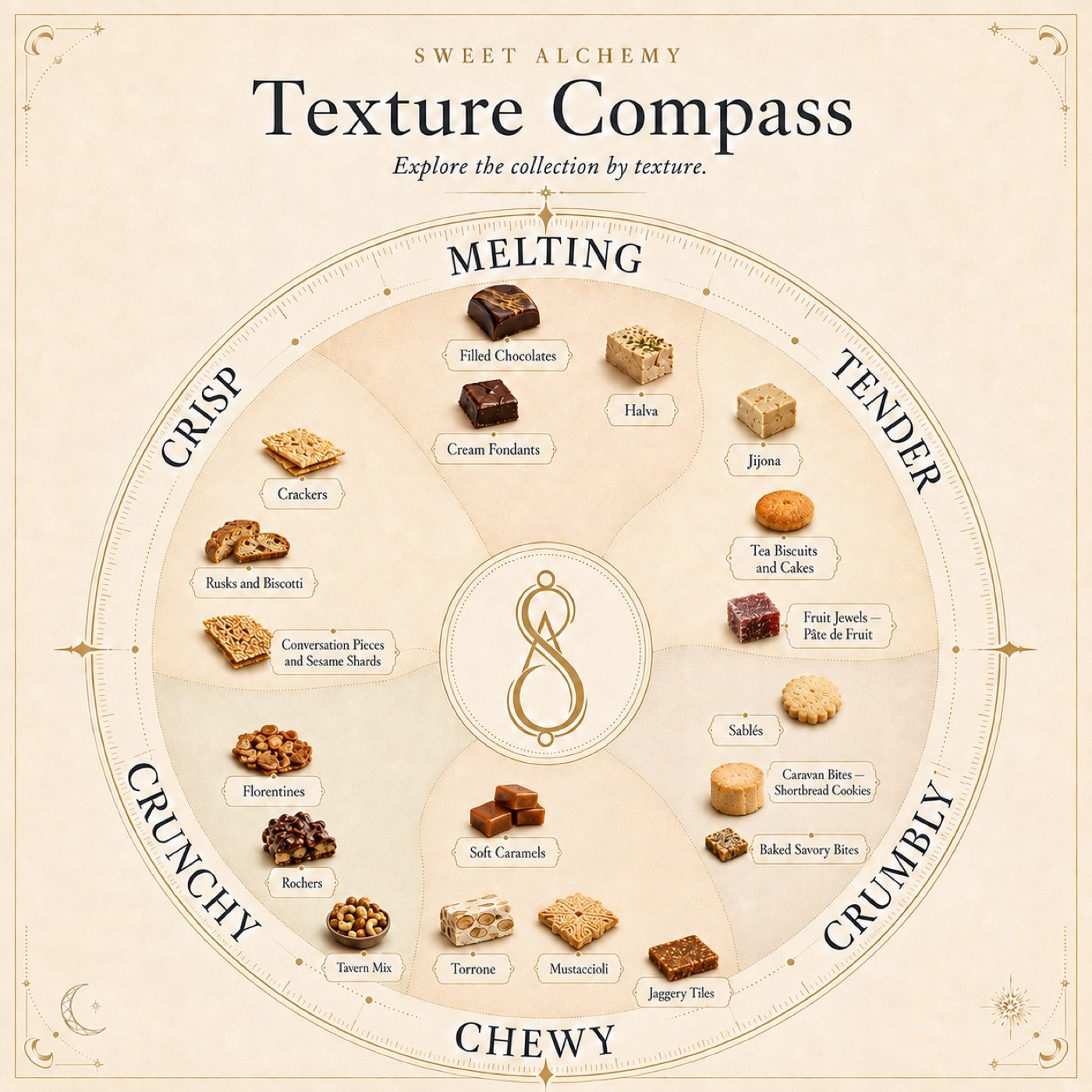
So the difference between something melting, tender, crumbly, chewy, crunchy or crisp is not merely descriptive language.
Each asks your mouth to behave differently.
That helps explain why texture can provoke such strong reactions. An unexpected crunch inside something soft can be startling. But a perfectly timed snap, crumble or chew can be every bit as memorable as the flavor itself.
At Sweet Alchemy, We Begin with Architecture
Many Sweet Alchemy provisions begin with an old recipe, a historical food description or a confection that has survived in some form for generations.
But inspiration is only the beginning. Very quickly, the question becomes:
What should this feel like when someone eats it?
Should it melt on the tongue? Yield gently? Break into sandy crumbs? Pull against the teeth? Fracture repeatedly? Snap cleanly?
Once we know the target texture, we work backward.
What must hold the food together? How much moisture should remain? Should fat weaken the structure or create melt? Do we need protein for support? Sugar for brittleness or chew? Air for lightness? Nuts or seeds for rigidity? A water-binding fiber or hydrocolloid for cohesion?
That is the ArchiTexture of a confection: the internal structure that ultimately determines what your mouth experiences.
Six Textures, Six Kinds of Architecture
| Texture | What helps create it | Sweet Alchemy examples |
|---|---|---|
| Melting | Fat crystals, nut and seed oils, fine particles and relatively weak structures that soften readily with warmth | Halva, filled chocolates, cream fondants |
| Tender | Moisture, fat, starch and protein arranged into a structure that holds together but yields under light force | Jijona, tea biscuits and cakes, fruit jewels |
| Crumbly | A deliberately weak structure, often with fat interrupting starch or protein networks so the food separates into small, sandy pieces | Caravan Bites, sablés, baked savory bites |
| Chewy | Controlled moisture combined with sugars, proteins, starches or water-binding ingredients that allow the structure to deform before breaking | Torrone, soft caramels, mustaccioli, jaggery tiles |
| Crunchy | Substantial rigid structures—especially nuts and seeds—often contained within a firm sugar or baked matrix | Rochers, Tavern Mix, florentines |
| Crisp | Thin, low-moisture structures that bend very little before suddenly fracturing | Conversation Pieces, sesame shards, crackers, rusks and biscotti |
The categories overlap intentionally.
A florentine can be crisp and crunchy. A sablé can be crumbly and tender. Halva can melt after a gentle yield. Torrone is chewy, but nuts add crunch.
That overlap is part of the pleasure.
Texture Is Built from Ingredients
Protein can create scaffolding and networks. Starch can provide body and structure. Sugar can become syrupy, elastic, crystalline or glass-like depending on concentration and temperature. Fat can soften, shorten, lubricate or melt. Water determines how mobile and flexible those structures remain. Air creates lightness and compressibility.
Even ingredients used in very small amounts can change the architecture dramatically. Psyllium, pectin, xanthan and other hydrocolloids interact with water and help alter viscosity, cohesion or gel structure.
Sweet Alchemy is gluten-free, so our chewy textures do not depend on the elastic gluten network found in conventional wheat-based baking. Instead, similar sensory qualities can be created through completely different combinations of concentrated sugars, proteins, starches, moisture, fibers and air.
The texture is the destination. The ingredients and techniques are how we get there.
Variety Is Satiety
When we build a tasting flight or pairing, flavor is only half the story.
Imagine five foods that are all sweet, soft and creamy. They may have completely different flavors, but after several bites the experience can begin to flatten.
Now introduce a crisp snap. Suddenly the mouth has contrast and rhythm. Different mechanics are required for each texture.
Strong crunch can also make eating feel more satisfying. It gives the jaw something substantial to work against, creating a clearer sense of resistance, fracture and completion with each bite. The sound and physical feedback can make the food feel more present and engaging, rather than simply disappearing.
When that crunch comes from whole nuts and seeds—the heart of Sweet Alchemy's ingredient portfolio—the experience is not only about texture. Their intact structures bring fats, proteins and fiber into the bite, along with a greater sense of substance. These components can take longer to chew and process than a uniformly soft, highly refined texture, helping contribute to the feeling that we have eaten something substantial and that the food stays with us.
Torrone: Pulling Texture from Thin Air
Torrone is one of the clearest examples of ArchiTexture because its texture changes dramatically during its creation.
It begins as syrup. Honey, sugar and water are heated into a concentrated syrup.
Then comes an ingredient we rarely think of as an ingredient: air.
Egg whites are whipped into a foam. Their proteins unfold and arrange themselves around countless tiny pockets of air, helping stabilize them.
The hot syrup is gradually incorporated into that foam.
Now the architecture changes. A liquid sugar system becomes an aerated mass. Tiny bubbles are suspended throughout a concentrated sugar matrix supported by protein.
As the mixture continues to whip and cool, it becomes progressively thicker, denser and more resistant.
Then toasted nuts are folded in. Now two very different architectures coexist: a yielding, aerated, chewy matrix + rigid, crunchy nuts.
When the torrone is first pressed into a slab, it is still warm, sticky and highly pliable. The architecture has been built, but it has not finished becoming itself.
As the slab rests, it cools. Moisture redistributes. The sugar-protein structure becomes increasingly stable. What began as a sticky aerated mass becomes something that can be cut, handled and finally bitten with the characteristic pull of torrone.
Texture isn't added at the end. It is built at every stage.
Sometimes the Best Texture Is Two Textures
Some of the most satisfying confections depend on contrast.
A chocolate shell fractures with a clean crack, then gives way to a soft or creamy center. A caramel may initially resist the teeth, then warm, soften and become increasingly yielding as it is chewed. A nut rocher combines a firm binder with repeated fractures from individual toasted nuts.
Texture can therefore be dynamic. What you experience during the first second of a bite may not be what you experience three seconds later.
That transformation is part of the pleasure.
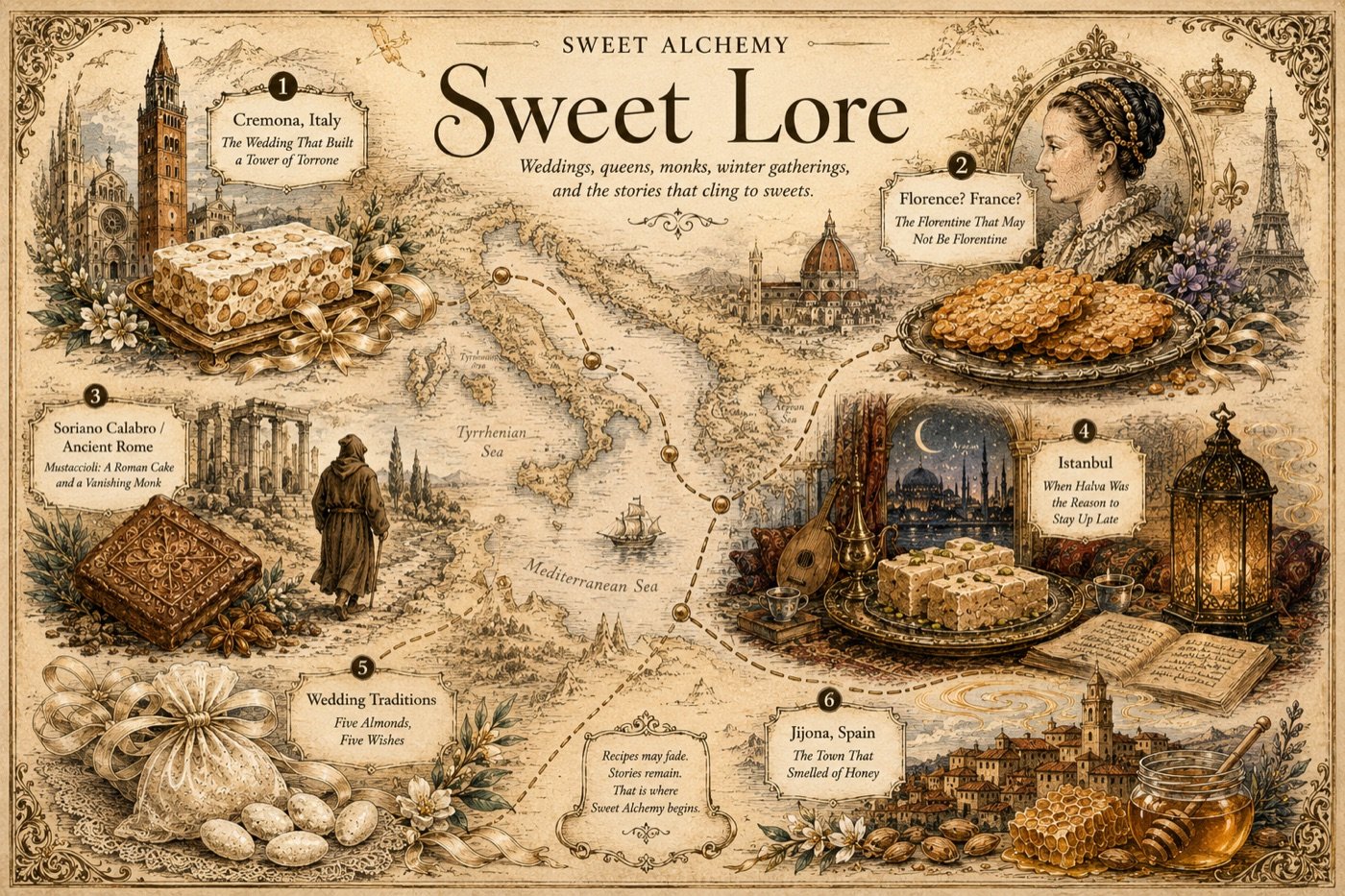
Food and storytelling have always made good companions.
We rarely seem satisfied knowing only what people ate. We want to know who made it, why it mattered and how the story began. Some of these answers are history. Some are tradition. Some have been repeated so many times that separating fact from folklore has become nearly impossible.
At Sweet Alchemy, we spend a lot of time looking backward for inspiration—through old recipes, regional traditions and descriptions of confections that have been made for generations. Inevitably, we find strange and intriguing stories.
Here are a few of our favorites.
The Wedding That Built a Tower of Torrone
Cremona, Italy. October 25, 1441.
Bianca Maria Visconti is marrying Francesco Sforza in one of Renaissance Italy's great dynastic weddings.
According to a beloved Cremonese legend, confectioners created a spectacular honey-and-nut sweet for the celebration and shaped it to resemble the city's towering bell tower—the Torrazzo.
From Torrazzo, the story goes, came torrone.
It is almost too perfect. And it probably is.
The City of Cremona itself describes the wedding story as legend; exactly when torrone first appeared there is uncertain. What we do know is that by the sixteenth century torrone was firmly established as a celebrated Cremonese specialty, important enough to be presented as a gift to dignitaries. (Comune di Cremona)
So did one extravagant Renaissance wedding really give us torrone? Maybe not.
But five centuries later, Cremona still celebrates the confection—and still tells the story of the wedding.
Sometimes a legend becomes part of a food's history simply because generations refuse to stop telling it.
The Florentine That May Not Be Florentine
Surely a Florentine comes from Florence. Except perhaps it doesn't.
One persistent story places the delicate nut-and-chocolate confection in the orbit of Catherine de' Medici, the Florentine noblewoman who became Queen of France in the sixteenth century. In one version, her influence on the French court inspired the name. Other versions involve French royal pastry cooks and visiting members of the Medici family.
The problem? The familiar Florentine appears to fit much more comfortably into the world of French confectionery, and Fortnum & Mason's own history describes it as a French creation while acknowledging the Catherine de' Medici legend. (Fortnum & Mason)
Which leaves us with a wonderful culinary mystery.
Perhaps Florence gave the confection its inspiration. Perhaps a Florentine queen gave it a name. Perhaps somebody simply thought a thin, golden disc deserved an appropriately glamorous title.
Whatever happened, one of the world's most recognizably Italian-sounding biscuits may not be Italian at all.
Mustaccioli: A Roman Cake and a Vanishing Monk
Mustaccioli carries not one origin story, but several.
Its name reaches tantalizingly far into the past.
Cato the Elder's De Agricultura, written in ancient Rome, includes instructions for mustacei: cakes made with flour moistened with grape must, seasoned with anise and cumin, enriched with fat and cheese, and baked over bay leaves. (The Eternal Table)
Modern mustaccioli are very different confections, but the linguistic connection to mustaceum has endured.
Then the story gets stranger.
In Soriano Calabro, in Calabria, local tradition tells of a mysterious monk who appeared in the town sometime in the early modern period, when monastic communities played an important role in local religious and social life. He offered mustaccioli generously to the townspeople—and then disappeared as mysteriously as he had arrived.
The story does not always identify the monk by name or explain exactly where he came from. In later local lore, however, the mysterious visitor became associated with San Domenico, the town's patron saint. That connection encouraged some people to interpret the monk as a holy messenger—or even as the saint himself, appearing in disguise to bring food and blessing to the community.
Whether people literally believed the monk had been sent by God is difficult to establish. The story is better understood as devotional folklore: a tale in which generosity, mystery and divine favor become attached to a beloved local sweet. Historical accounts, meanwhile, point toward monastic communities as important promoters of the local confectionery tradition. (La Cucina Italiana)
So which story do we choose? Ancient Roman grape-must cake? A confection shaped by medieval and early modern religious communities? A mysterious monk who may have been understood as a saint in disguise?
Perhaps all of them. A food that survives long enough tends to collect stories along the way.
When Halva Was the Reason to Stay Up Late
Imagine Istanbul on a winter evening during the Ottoman era, perhaps in the eighteenth or early nineteenth century.
People gather indoors. There is music. Conversation. Poetry. Games. And halva.
Ottoman culture developed a tradition known as helva sohbeti—halva conversations or gatherings—where making and eating halva became part of winter social life. These gatherings belonged to the social world of the Ottoman Empire, which lasted from the late thirteenth century until 1922, and were especially associated with the urban culture of Istanbul.
The gatherings became so culturally recognizable that after Sultan Mahmud II abolished the Janissaries in 1826 and authorities became wary of unauthorized public assemblies, even neighborhood halva gatherings could draw suspicion. An Istanbul historical account describes a group of young men being arrested in 1830 after gathering for music, games and a traditional halva evening. (Istanbul Encyclopedia)
Imagine having your dessert party mistaken for political agitation.
The halva served at such gatherings belonged to the enormous Ottoman family of helva rather than necessarily being the sesame halva familiar to us today. But that makes the story more interesting, not less.
For centuries, halva has meant more than one thing. It has been a family of sweets—and an excuse to gather around a table.
Five Almonds, Five Wishes
At an Italian wedding, you may be handed a small bundle containing five sugar-coated almonds.
Not four. Not six. Five.
The traditional confetti represent five wishes for the newlyweds: health, wealth, happiness, fertility and longevity.
The odd number also carries symbolism: it cannot be divided evenly in two, making it an apt little metaphor for an indivisible marriage. Greek wedding koufeta similarly appear in odd-numbered groupings. (The Knot)
It is an extraordinary amount of meaning to place inside a candy shell.
An almond is already a contrast—hard, nutty and faintly bitter beneath something sweet. Coat it in sugar and suddenly it can stand for the complicated bargain of marriage itself: hardship and sweetness, wrapped together.
A dragée becomes a blessing you can eat.
The Town That Smelled of Honey
Not every good food story requires a queen or a wedding. Sometimes all you need is a smell.
In the Spanish town of Jijona, almond-and-honey confectionery became so deeply embedded in local life that a historical account cited by the town's turrón tradition records an evocative description from 1585:
“In every house in Jijona, it smells of honey.” (Jijona)
That may be my favorite image of all. Not one confectioner. Not one palace kitchen. An entire town.
Imagine walking down a sixteenth-century street while household after household cooks almonds and honey into turrón.
Jijona would eventually lend its name to its own distinctive soft style of turrón, made by grinding almonds into the confection rather than leaving them whole.
But before technique, designation and regulation, there was simply the smell of honey drifting from people's homes.
Why We Keep the Stories
Food lore is not always reliable history.
Catherine de' Medici probably cannot be credited with every French dish attributed to her. A wedding banquet almost certainly did not invent the entire nougat tradition. A disappearing monk is difficult to footnote.
That isn't a reason to discard the stories. It is a reason to label them for what they are.
Legends tell us something that recipes cannot. They tell us what a food came to mean to the people who ate it.
Marriage. Prosperity. Hospitality. Celebration. Community on a winter night. The possibility that a stranger might arrive bearing a blessing. The smell of honey coming from the house next door.
At Sweet Alchemy, the history gives us somewhere to begin.
The lore reminds us why people kept making these foods long enough for us to discover them.
At Sweet Alchemy, few ingredients feel more at home than sesame and honey.
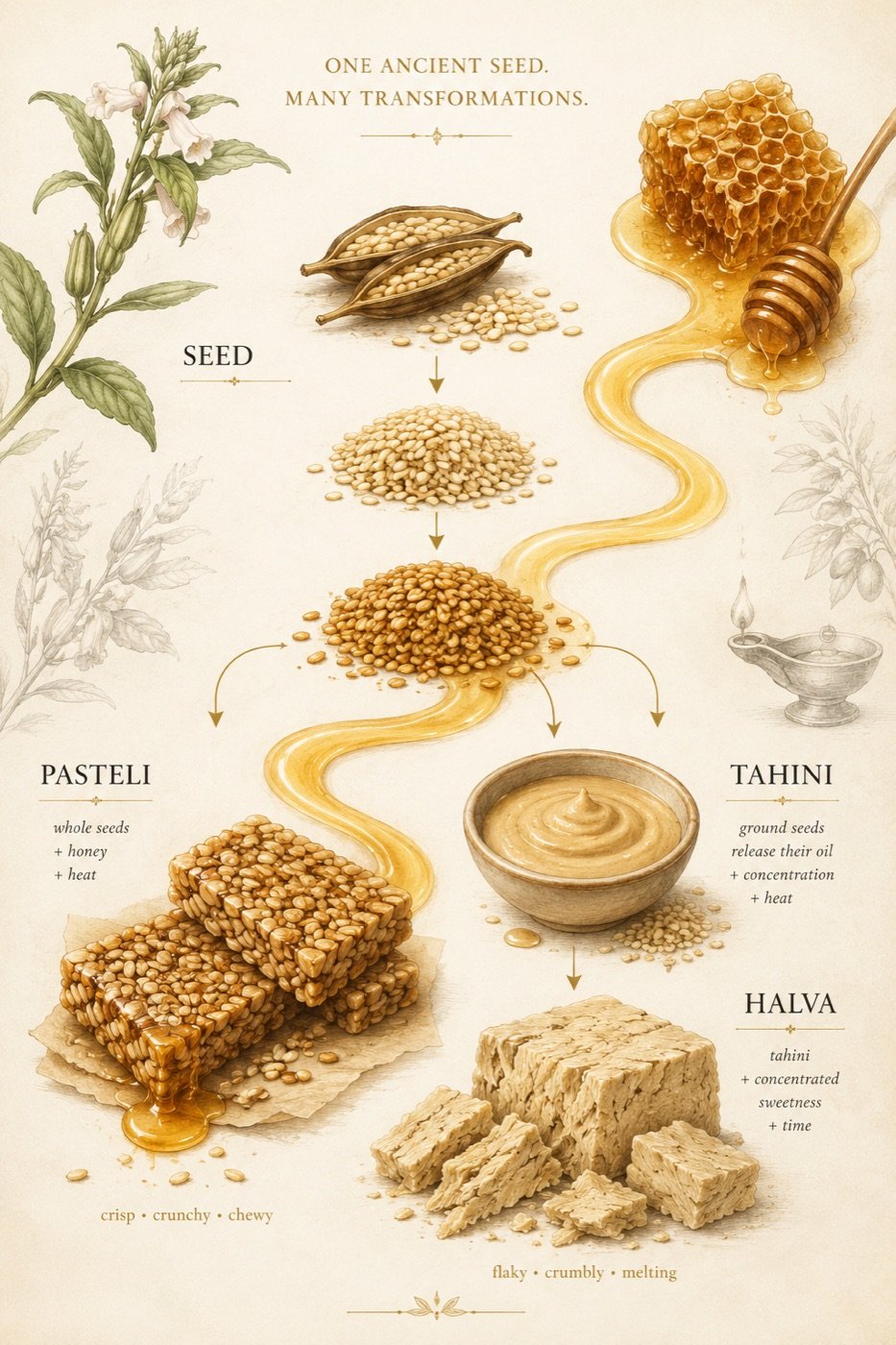
They are simple, recognizable ingredients, but neither is simple in what it can do. Honey brings sweetness, viscosity and binding power. Sesame brings toasted flavors, fat, protein and structure. Leave the seeds whole and they crunch. Grind them, and their hidden oils transform them into a flowing paste.
Together, sesame and honey can become almost any texture imaginable. And humans discovered the appeal of this pairing a very long time ago.
Ancient Greek sources describe sesame confections by the seventh and sixth centuries BCE. Later ancient texts refer specifically to sweets combining sesame and honey, including ground sesame preparations and sesame roasted for use with honey. They were not necessarily the pasteli or halva we know today, but the central idea is unmistakable: people were already turning sesame and sweetness into confections more than 2,500 years ago.
But the story of the partnership begins even earlier than that. To understand why honey and sesame found each other so successfully, we first have to pull them apart.
Hey There, Honey
Long before humans learned to refine sugar, bees were already concentrating sweetness for us.
Exactly when a human first reached into a wild hive and tasted honey is unknowable. It almost certainly predates written history by an enormous margin.
What archaeology can tell us is that humans were regularly exploiting honeybees by at least the seventh millennium BCE—roughly 8,000 to 9,000 years ago. Researchers have identified the chemical fingerprint of beeswax preserved inside Neolithic pottery across Europe, the Near East and North Africa, while prehistoric rock art also appears to depict honey hunting.
Why go to the trouble? Humans are biologically drawn to sweetness because it signals readily available carbohydrate and energy. Other primates seek it too, including by raiding bee colonies.
Honey must have been particularly remarkable: an intensely sweet, aromatic food already concentrated by bees, rather than the more diluted sweetness of fruit.
And honey brought another advantage that would eventually become important to confectionery: it was sticky.
Then Open Sesame
Sesame enters the human story differently. While honey could be found, sesame had to be cultivated.
Archaeological finds from the Indian subcontinent place cultivated sesame in use by roughly 3500–3050 BCE, making it one of humanity's ancient oilseed crops.
And what an oilseed it is. Roughly half of a sesame seed can be oil. That made sesame valuable not only as something to eat, but as a concentrated source of fat that could be pressed and used in cooking.
Sesame oil eventually found other uses as well; archaeological evidence from later historical contexts even shows it being burned as lamp fuel.
As sesame traveled westward, the seed itself became part of breads, cakes, seasonings and eventually sweets. By the Mycenaean period, a word for sesame appears in Linear B records from roughly 1400–1200 BCE, showing that it had reached the Aegean world.
But the most interesting thing about sesame may be what happens when you change its physical form.
Eat a seed whole and it gives you a tiny, firm bite. Toast it and its aroma deepens dramatically. Crush it and the structure begins to break down. Grind enough sesame and something almost magical happens: thousands of tiny seeds release their oils and become tahini.
The ingredient has not changed. Its architecture has.
That ability to transform is one reason sesame remains so important in the Sweet Alchemy pantry.
When Sesame Met Honey
The poet Stesichorus, writing in the seventh or sixth century BCE, mentions a sesame confection called sasamis. Other ancient terminology refers more explicitly to confections of honey and sesame, including melipekton and kopte sesamis, the latter involving ground sesame. Philoxenus, in the fifth or fourth century BCE, even describes roasting sesame for sweets made with honey.
Honey provided sweetness and a binding matrix. Sesame provided aroma, fat, protein and physical structure.
Together, they became confectionery.
Pasteli: The Ancient Idea You Can Still Recognize
If you want to understand why sesame and honey have endured together for so long, pasteli may be the clearest place to begin.
At its simplest, the proposition is almost startlingly direct: sesame + honey + heat.
The seeds remain recognizable. Honey surrounds and binds them.
Technique can still push the finished sweet in different directions. More moisture can produce something softer and chewier. Greater concentration can create a firmer crunch or brittle snap.
Ancient sesame-and-honey sweets should not simply be declared identical to modern pasteli; recipes change, names migrate and traditions evolve.
But the idea is strikingly familiar. Whole seeds. Honey. Heat. Structure.
Trick Up the Sleeve
Sesame can open up an entirely new culinary world with one simple step: grind it.
Instead of hundreds of individual seeds, the seed structure disappears. The oils are released. The particles become extraordinarily fine. What was once crunchy becomes creamy and fluid.
Now we have tahini. And from tahini comes an entirely different expression of sesame confectionery: tahini halva.
The word halva belongs to a much larger family of sweets. It comes from the Arabic halwā, essentially meaning something sweet, and historically referred to many preparations rather than one fixed recipe. Medieval Arabic cookbooks record several forms of halwa; centuries later, Ottoman sources describe tahin helvası, a sesame-paste halva recognizable as part of the tradition we know today.
Halva is one of those foods that can surprise on the first bite. It looks dense, perhaps even heavy. Then it fractures into fine layers, crumbles delicately and begins to melt.
Done well, it occupies that peculiar territory between crumbly, flaky and melting.
Pasteli and Halva: Similar Ingredients, Opposite Experiences
Put pasteli and tahini halva beside each other and the differences are stark.
In pasteli, the sesame seeds retain their individual structures. Your teeth encounter seed after seed, held together by a concentrated sweet binder. The experience can be chewy, crunchy or—very commonly today—crisp.
In halva, those seeds have already been mechanically dismantled. Their oil and microscopic particles form tahini, which is then woven into a concentrated sugar structure.
One keeps the seed intact. The other takes the seed apart.
One asks you to bite and fracture. The other crumbles, softens and melts.
The same ingredient can land on nearly opposite sides of our Texture Compass.
That is one of the principles behind ArchiTexture at Sweet Alchemy: ingredients give us possibilities. Technique determines what those ingredients become.
Why We Keep Coming Back to Them
Sesame and honey remain central to Sweet Alchemy not merely because they are ancient. They are useful. They taste extraordinary. And they work.
That versatility lets the same ancient ingredients appear in very different parts of our collection—from halva and pasteli to sesame shards and Conversation Pieces.
More than 2,500 years after Mediterranean writers began recording sesame sweets, the combination still feels worth exploring.
Find Sweet Alchemy
Sweet Alchemy pops up throughout North Texas at local markets, specialty shops, festivals, tastings and seasonal events.
Shop locally at Wise Roots Market in Decatur, and find Sweet Alchemy at The Local Markethouse in Roanoke.
You can also find us at markets and community events in Flower Mound, Argyle, Robson Ranch and other North Texas communities, with additional pop-ups at festivals and special gatherings throughout the year.
Upcoming Events — Fall & Holiday 2026
- October 7 — Trophy Club
- October 9 — Lewisville Lake Symphony: Rachmaninoff Evening
- October 10 — Bonnie & Clyde Days · Pilot Point
- November 5–7 — Reindeer Group · The Colony
- November 13 — Lewisville Lake Symphony: Capriccio Espagnol
- November 28–29 — Christmas in Grapevine Arts & Crafts Show · Grapevine Convention Center
More seasonal dates are added throughout the year. Follow Sweet Alchemy on social media for the latest markets, pop-ups and event details.
Give Something Worth Remembering
Thoughtful gifts, beautifully curated.
Handcrafted, gluten-free sweets and savories, packaged with care and ready to give. Many selections are shelf-stable, making them easy to plan ahead for—and especially useful for the people who are hardest to buy for.
Gifts for all kinds of moments.
Host gifts · Thank-yous · Birthdays · Housewarmings · Retirements · Milestones · Client gifts · Corporate gifting · Weddings · Events · Holiday gifts · “Just because”
Don’t bring the same store-bought cookies, cupcakes or boxed chocolates. Bring something more memorable.
Think Outside the Candy Box.
A Few Sweet Alchemy Gifts
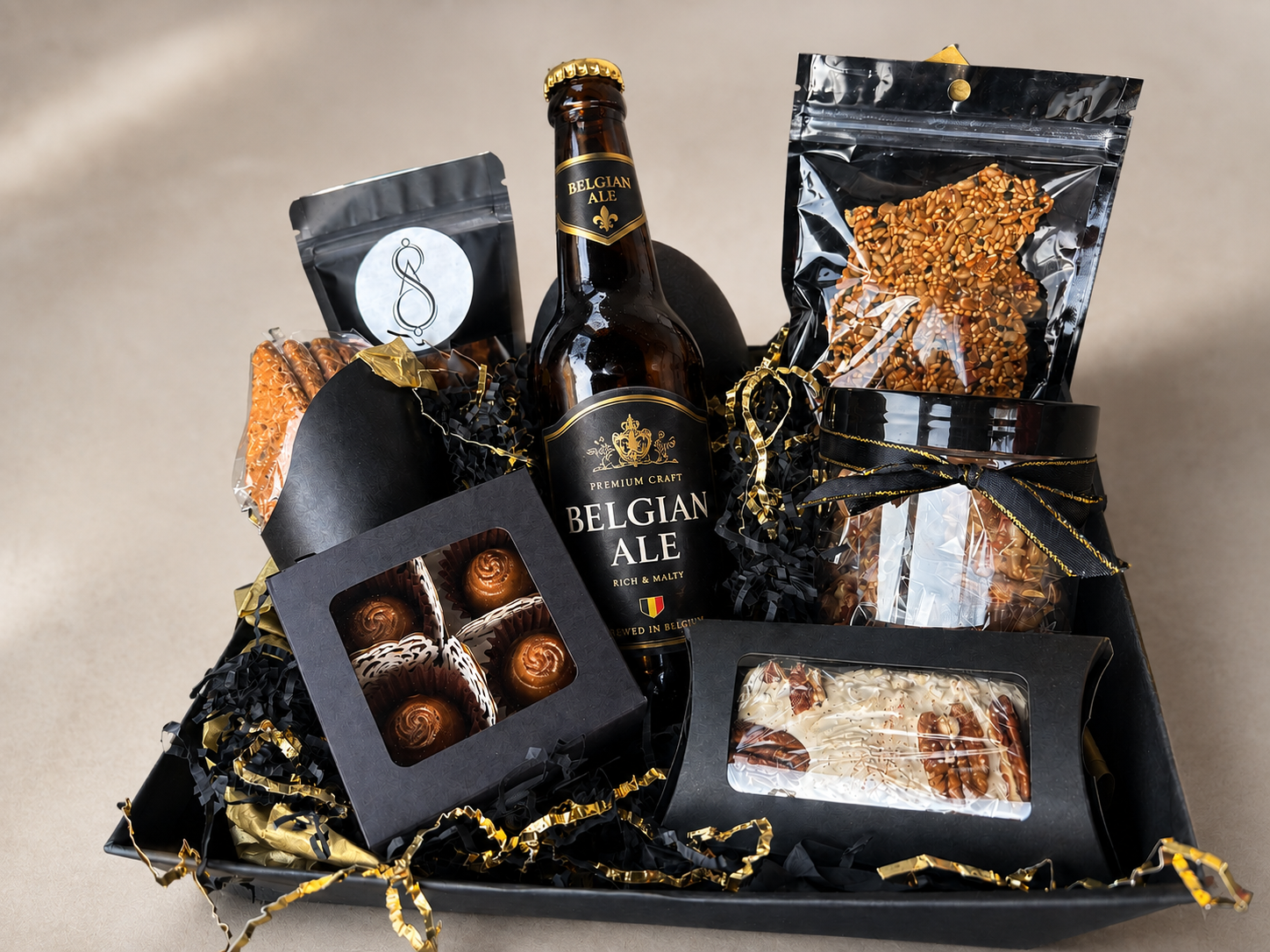
See petite gifts, curated boxes, wine-pairing baskets and custom presentations.
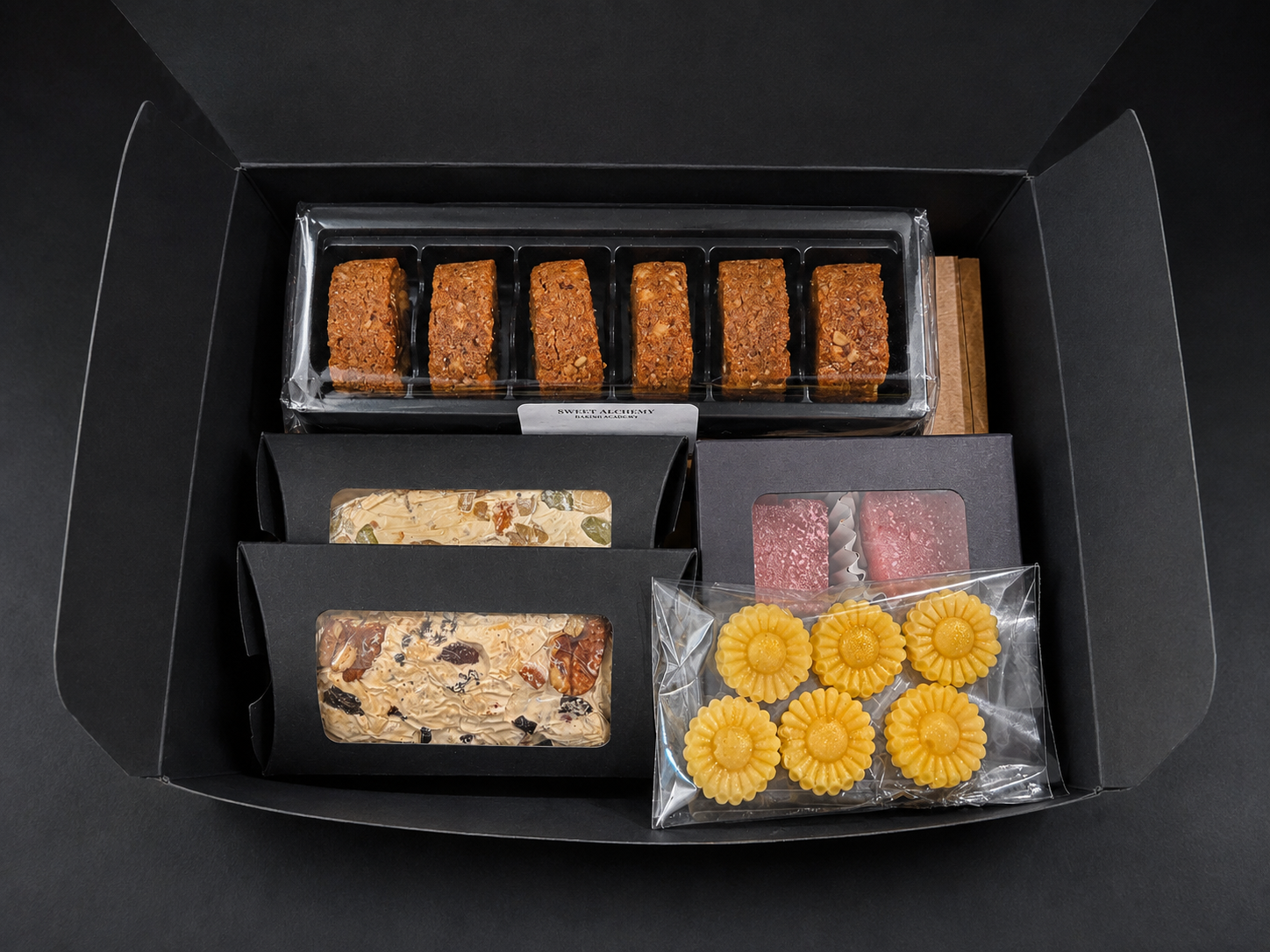
Petite Gifting
From $25A small gesture with plenty of personality.
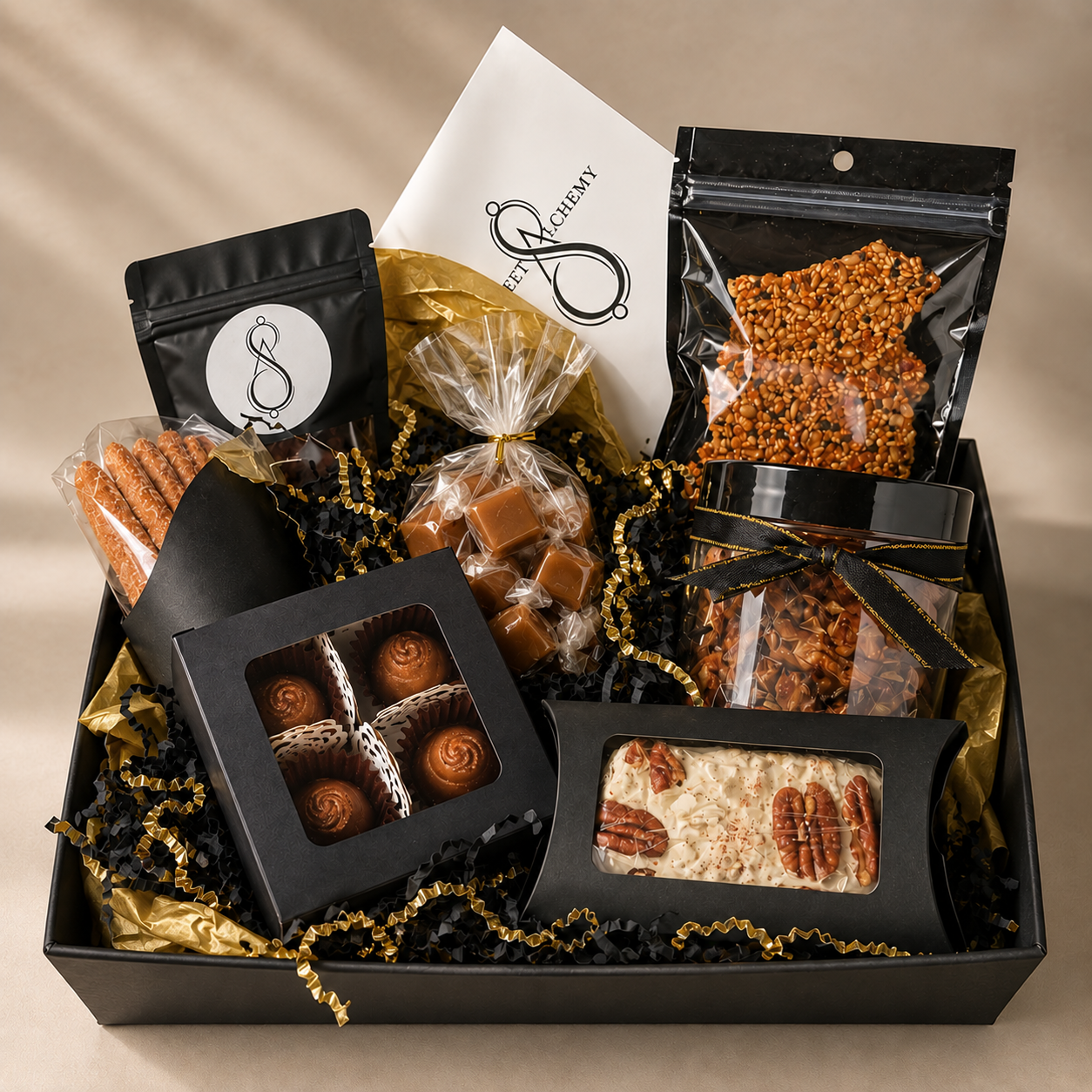
Curated Gifts
From $45A generous assortment, thoughtfully selected and beautifully presented.
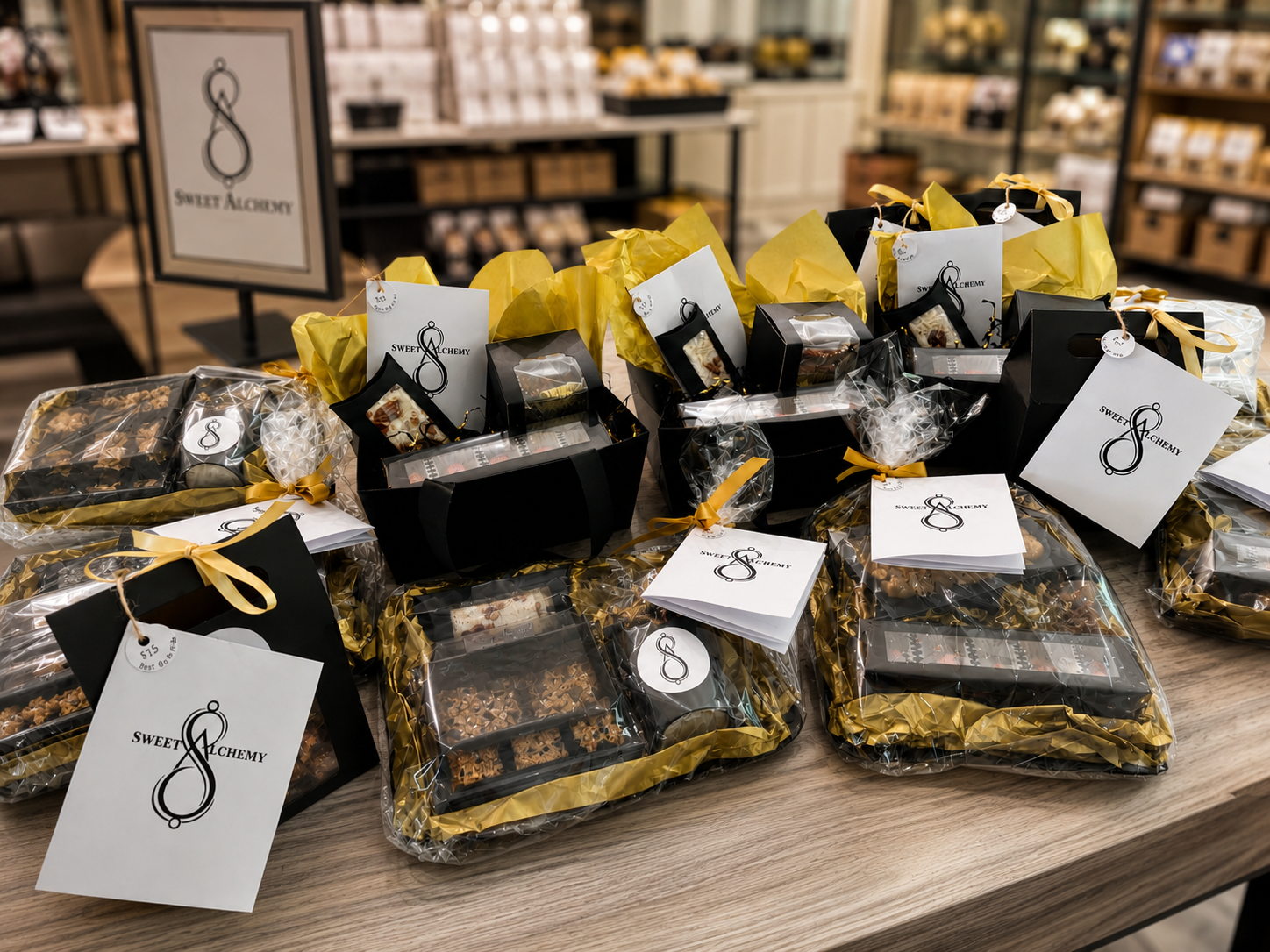
Custom, Corporate & Event Gifting
Custom pricingLarger boxes, baskets and branded gifting built around your occasion.
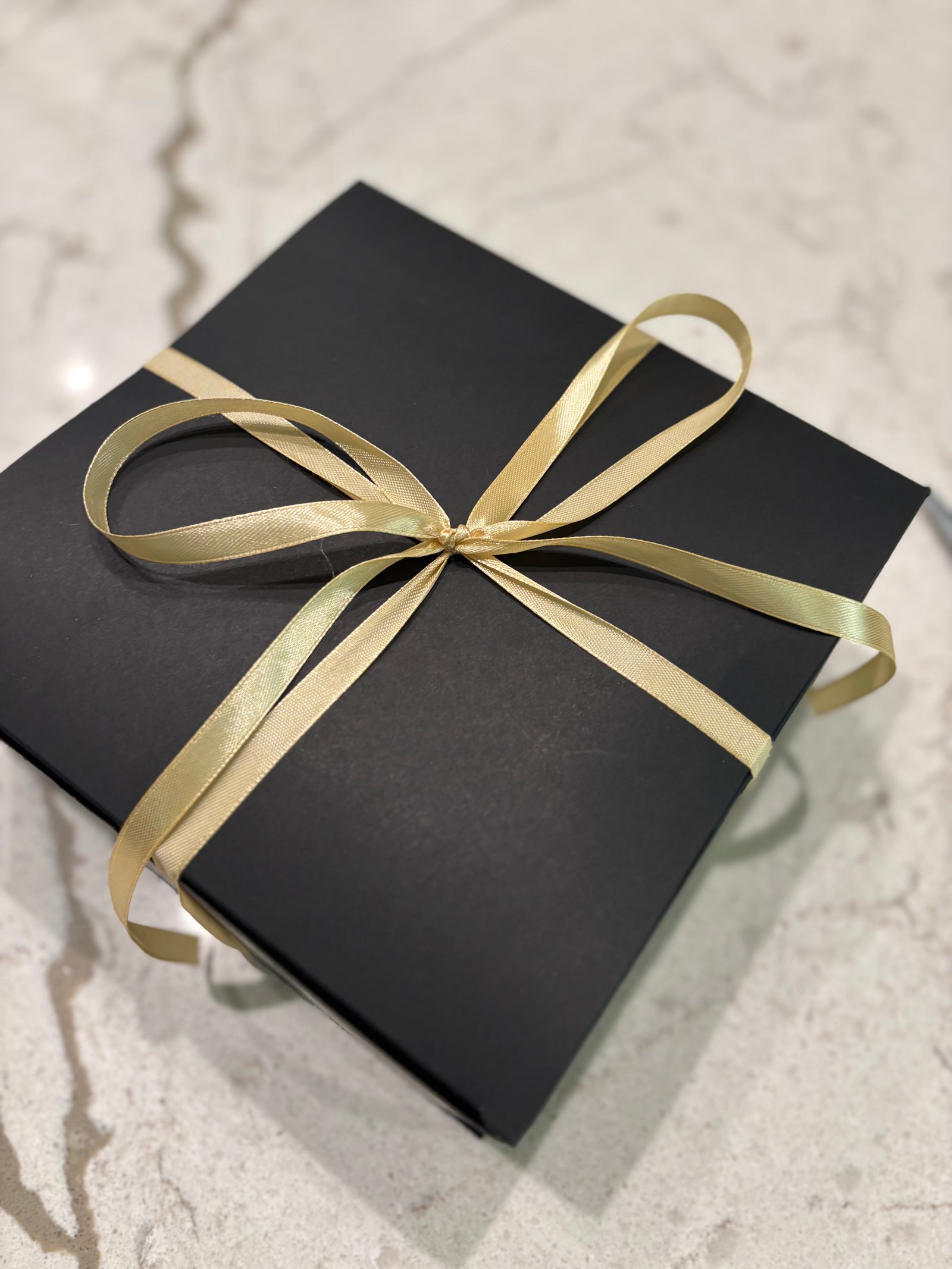
Seasonal: Christmas & Winter
Coming SoonLimited seasonal boxes and baskets for holiday gifting.
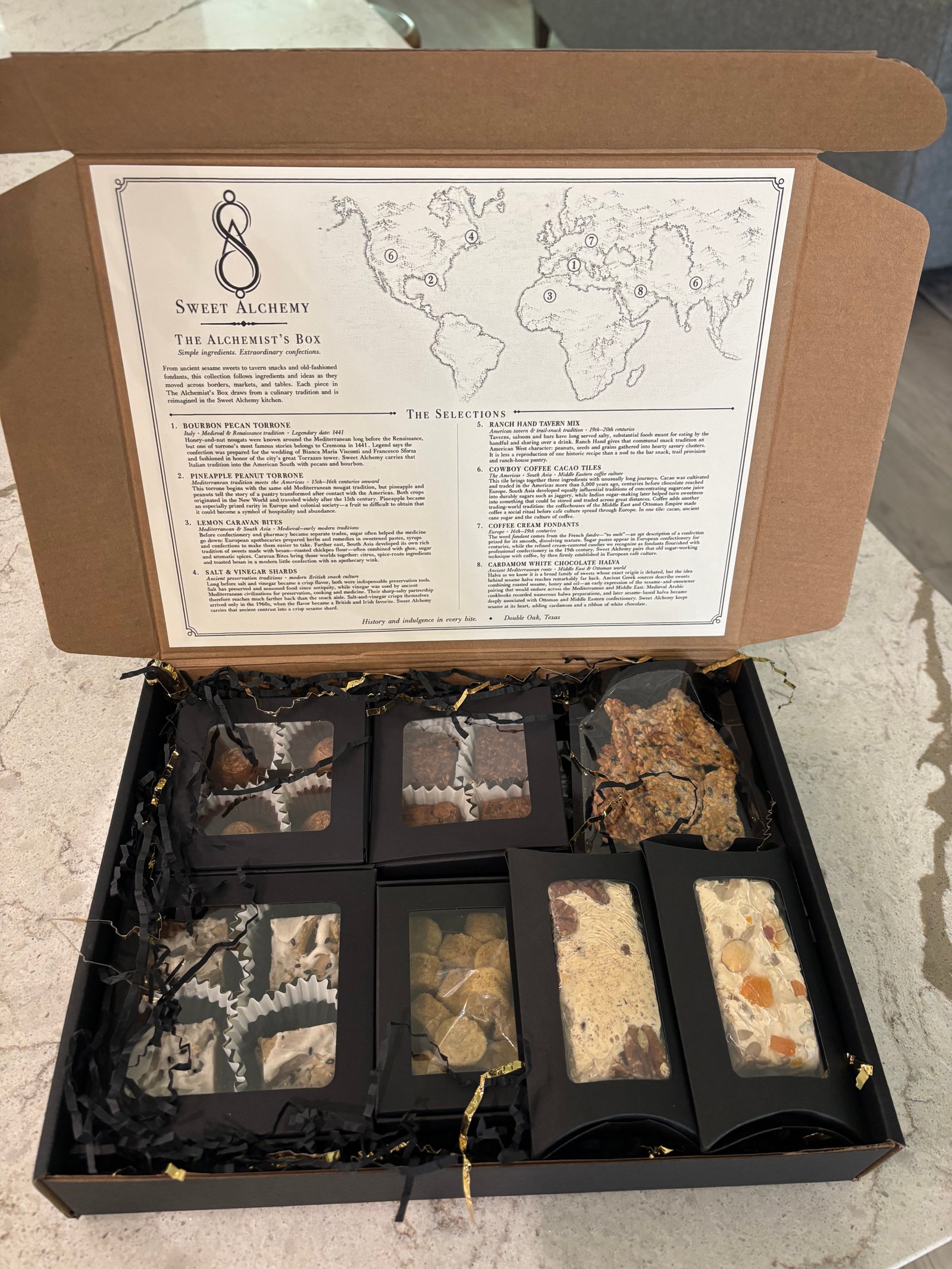
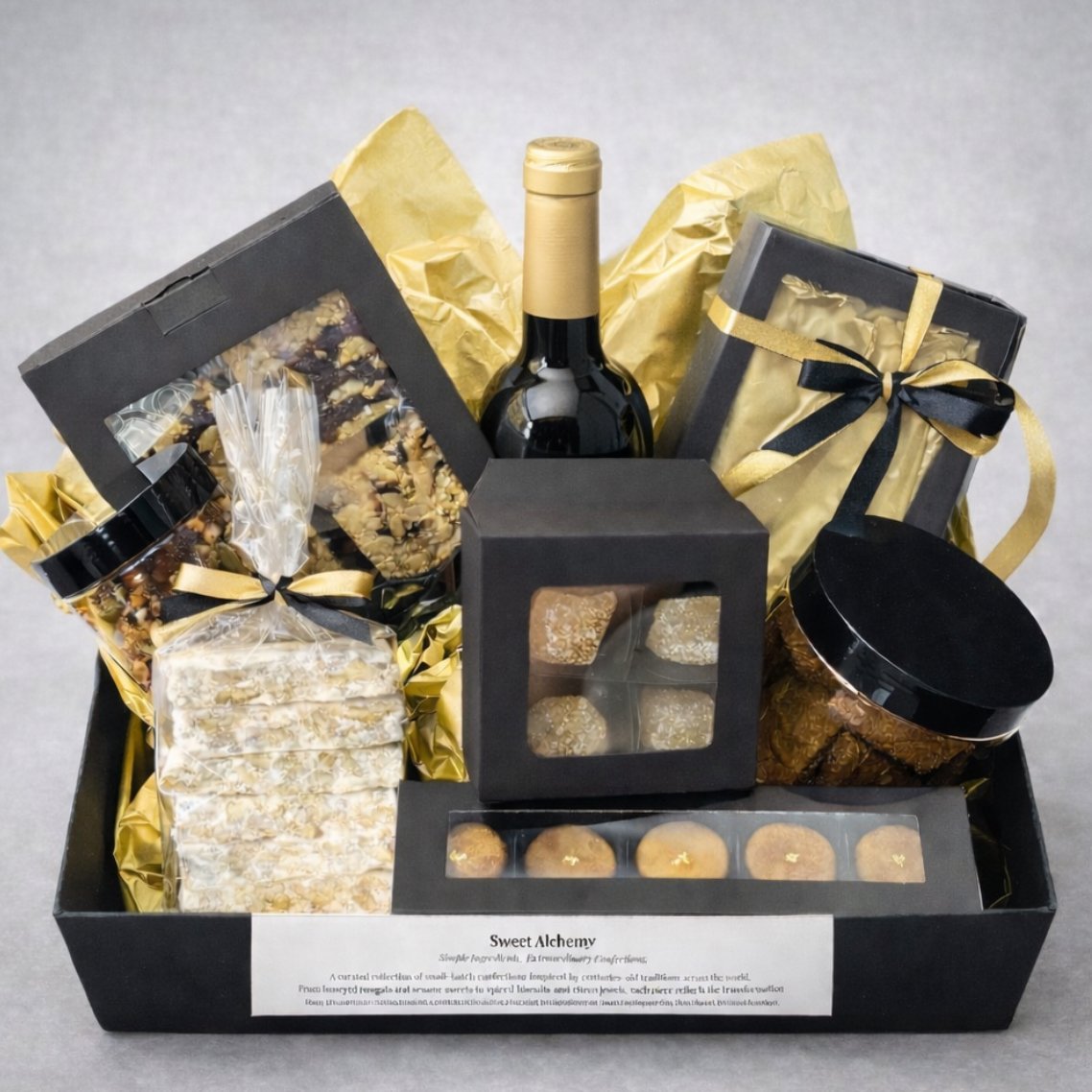
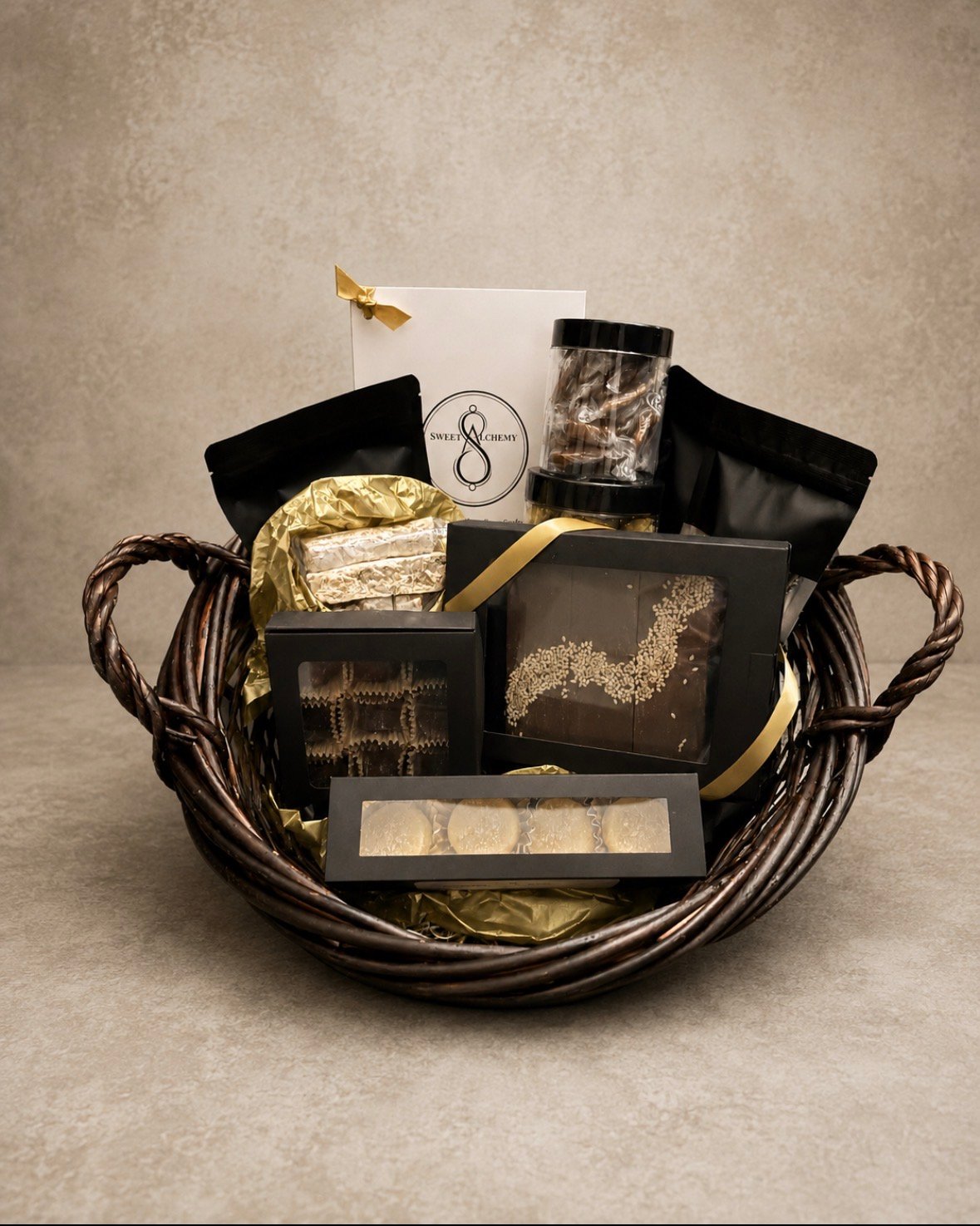
A closing gift built around the recipients and the occasion.
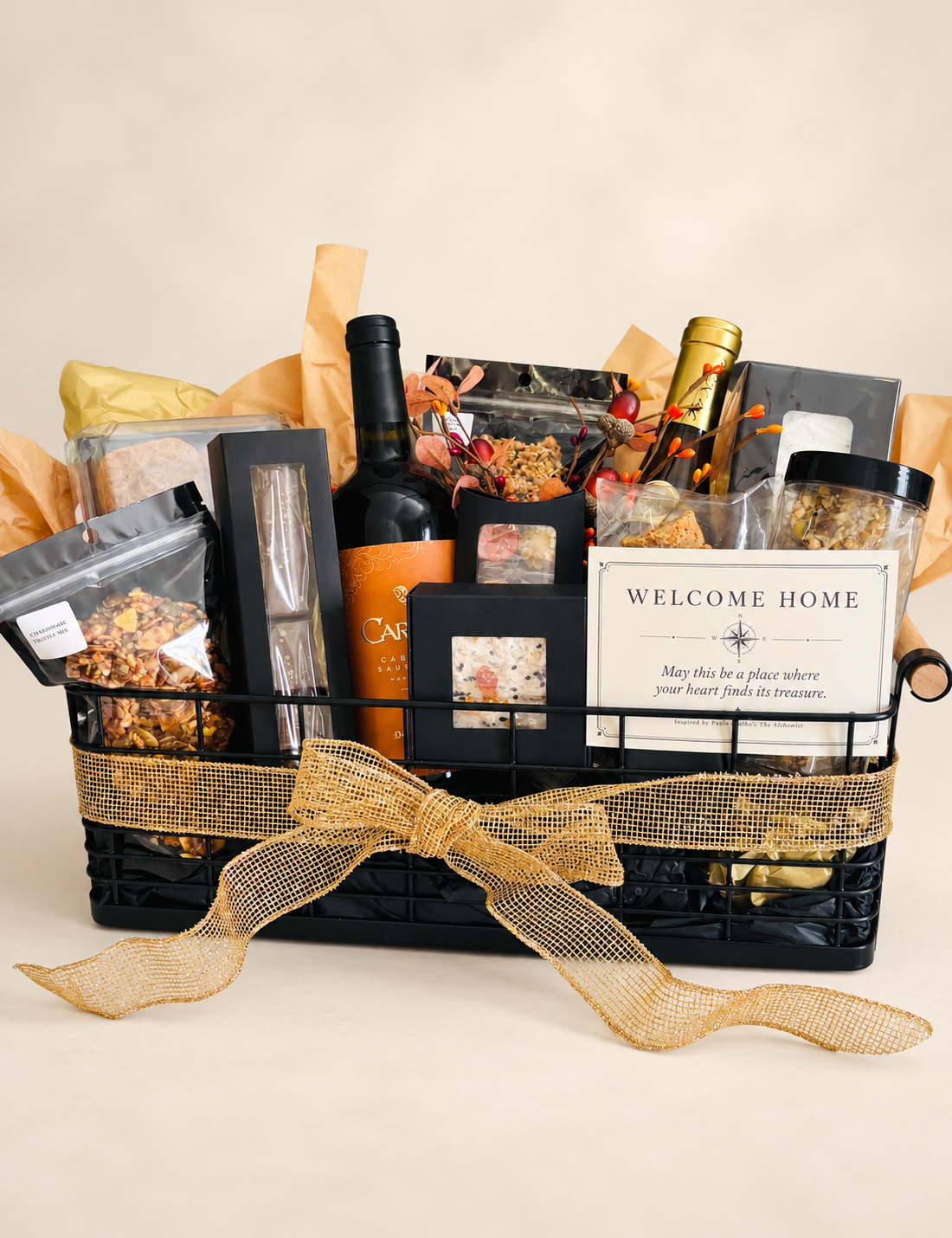
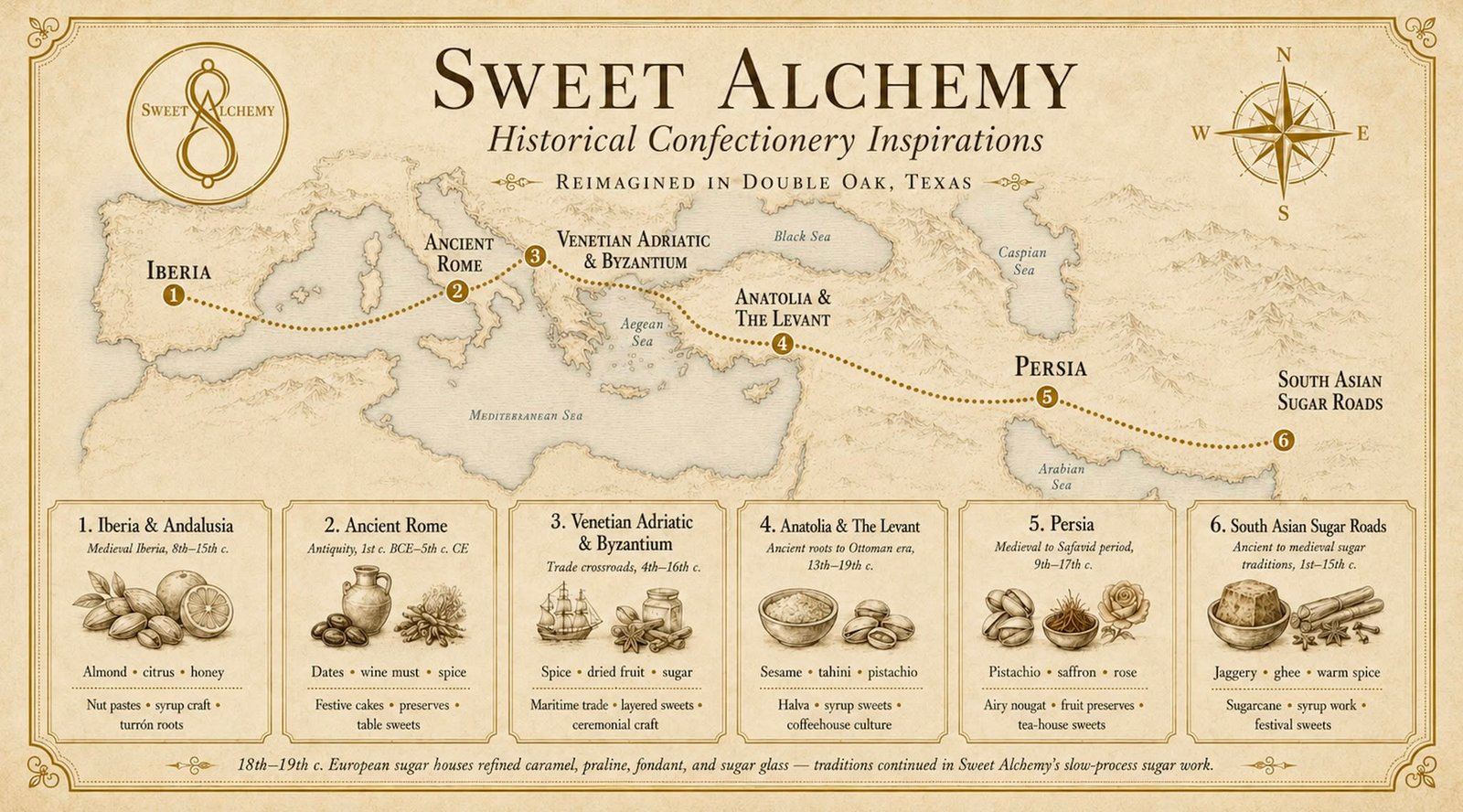
A curated assortment of Sweet Alchemy sweets and savories was designed to pair with Chardonnay and Cabernet, presented with a map, curation notes and short histories tracing the origin of each confection—so every selection also tells a story.
Give Guests Something to Talk About.
Bring a world of flavor to the table.
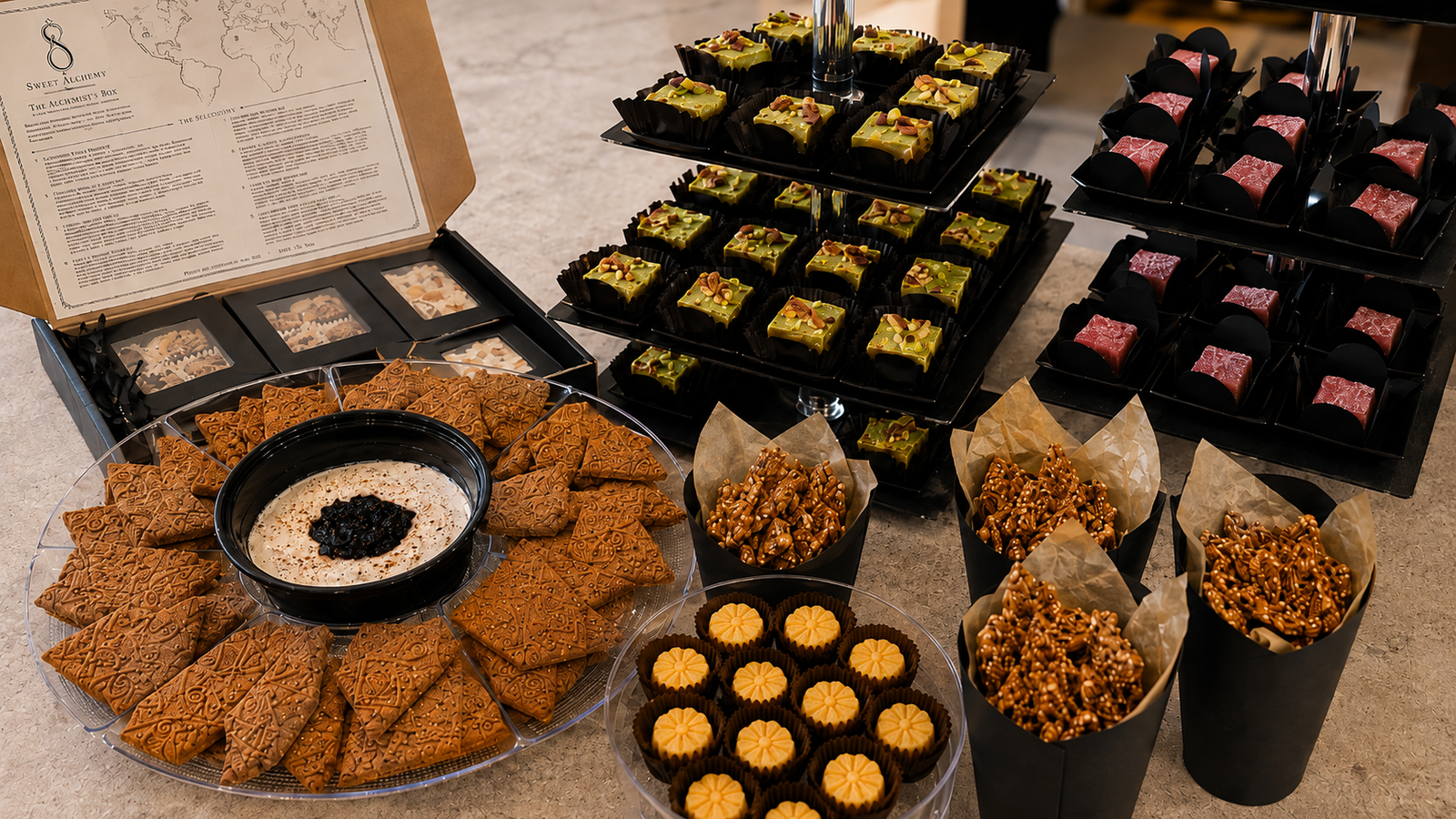
History, global flavors and unexpected combinations come together to create memorable experiences your guests will love to discover.
 01
Tasting Flights
From $15 / personTaste. Compare. Discover.
- A flavor or ingredient
- A region, culture or trade-route journey
- A texture or technique
- A historic era or season
 02
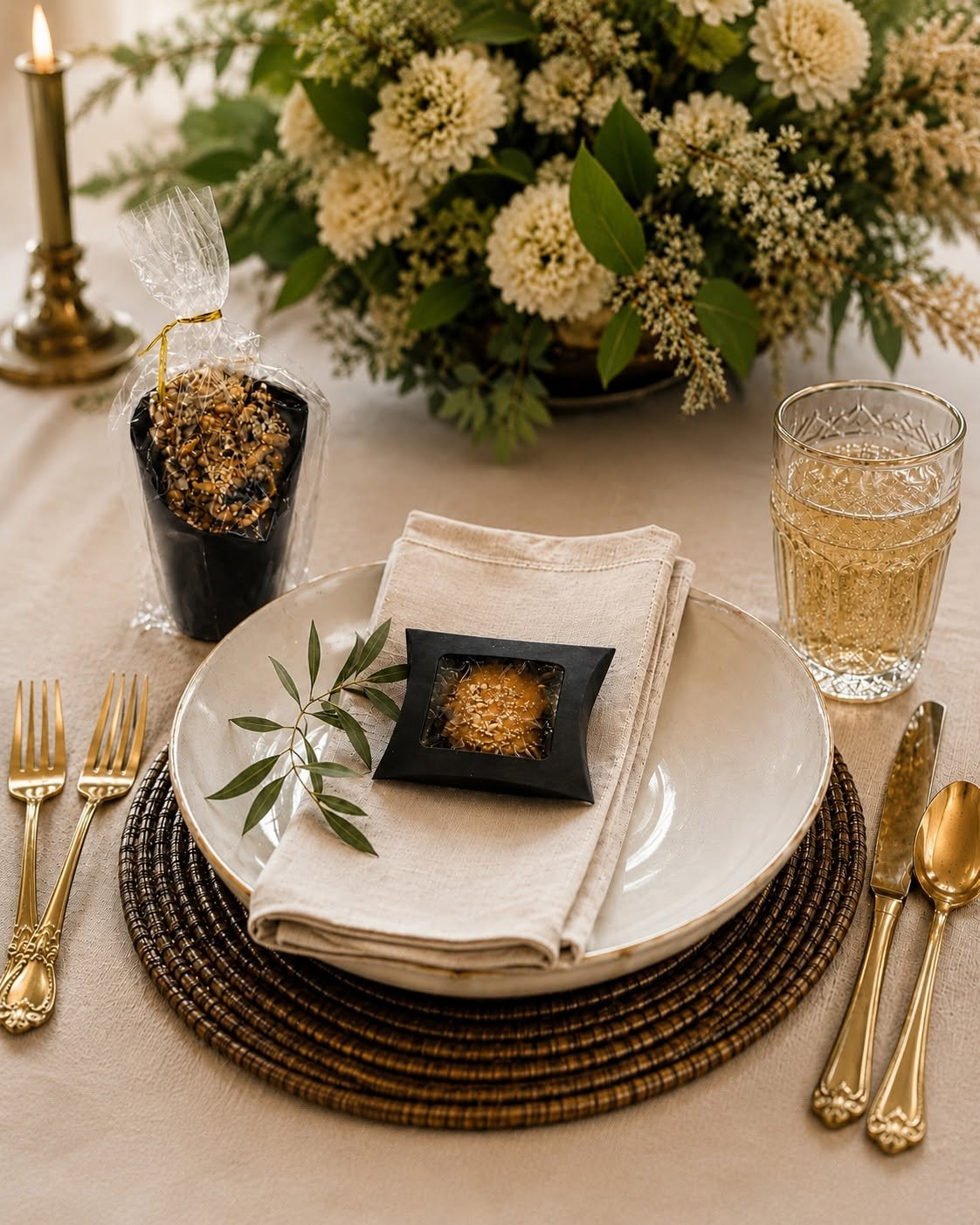
Pairing Boxes & Baskets
Built around what you're pouring, serving or celebrating.
- Charcuterie boards
- Wine nights & dinner parties
- Game nights & movie nights
- Auctions & fundraisers
- Guest favors & take-home treats
 03
Gatherings & Events
A Sweet Alchemy experience built around your gathering.
- Receptions & celebrations
- Corporate events & client gifts
- Hosted tastings & workshops
- Custom menus & pairings
Have an idea? Tell us what you're planning.
About Sweet Alchemy
Seeds of Antiquity. Flavors of Today.
Sweet Alchemy began, in part, with a fascination for recreating the turrón my mother remembered from her time in Spain.
Certain turrón, torrone and nougat can take up to 48 hours from cooking through resting and drying before they are ready to package.
Making these confections forced me to slow down. There is something remarkable about the way simple, whole-food ingredients can carry so much history, culture and meaning. I'm drawn to ingredients that are recognizable, thoughtfully chosen and as minimally refined as practical, allowing their natural flavor, texture and character to do the work.
“The simplest things are also
the most extraordinary things.”
Flavors Travel.
Sweet Alchemy is inspired by the way ingredients, techniques and traditions have moved across cultures and centuries—from Mediterranean sweets and Silk Road exchange to Renaissance encounters between Old World traditions and New World ingredients.
Ancient traditions. Mediterranean influence. Old-world European confectionery. Global ingredients. Modern imagination.
A world of flavor, brought to your table.
Food has always brought people together across time, geography and cultures, and I love helping others create meaningful moments of fellowship and discovery. Sweet Alchemy exists to turn the rich history of food into modern moments of discovery, fellowship and unforgettable experiences.
Handcrafted in small batches in Double Oak, Texas.
For more of the history, discoveries and lessons I've gathered along the way, explore Alchemist's Notes.
Think Outside the Candy Box.